NEWS

22 August 2023

Looking back at the Apollo moon landings

Looking back at the Apollo moon landings

The success of Artemis I means we’re looking at the exciting prospect of returning humans to the moon. If all goes to plan, humans may step onto the moon’s surface again as early as 2025, during the planned Artemis III mission.

With the moon once more within reach, it feels like an appropriate time to reflect on the last time humans really connected with it. This article is the first of a series looking at humanity’s first steps on the moon.

The success of Artemis I means we’re looking at the exciting prospect of returning humans to the moon. If all goes to plan, humans may step onto the moon’s surface again as early as 2025, during the planned Artemis III mission. The Artemis moon missions are building on what we learnt from the Apollo moon missions in the 1960s and 1970s, and the naming of the Artemis programme reflects that. Artemis was the Greek goddess of the moon, making the name particularly apt, but she was also the twin sister of the sun god Apollo. With the moon once more within reach, it feels like an appropriate time to reflect on the last time humans really connected with it. This article is the first of a series looking at humanity’s first steps on the moon. In this introductory post, we’ll talk about how many people have been to the moon and how they survived on its surface. How many people have walked on the moon? There have been six crewed moon landings in total, all of which were part of NASA’s Apollo programme: Apollo 11, Apollo 12, Apollo 14, Apollo 15, Apollo 16 and Apollo 17. To date, only 12 people have stepped onto the surface of the moon: two astronauts from each of the listed Apollo moon landings. All of them were white American men, and all of them performed their moonwalks between July 1969 and December 1972: the span of just three and a half years, over half a century ago. Including the 12 who have walked on it, 24 people in total have travelled to the moon. Again, all of these journeys took place during the Apollo programme. Each of the six moon landings included a third crew member who orbited the moon without landing, and the crewed missions Apollo 8, Apollo 10 and Apollo 13 also visited the moon, although they didn’t land. Three astronauts – Jim Lovell, John Young and Gene Cernan – have travelled to the moon twice, which is why these nine missions with three-person crews add up to 24 people, rather than 27. Artemis II, scheduled to launch and travel around the moon next year, is expected to add four more people to the number of moon visitors: Victor Glover, Jeremy Hansen, Christina Koch and Reid Wiseman. How did Apollo astronauts survive on the moon? There were a lot of challenges to overcome in order for the astronauts to be able to survive and explore comfortably on the moon. For example, their spacesuits needed to be pressurised, as humans cannot survive in a vacuum. Here are a few of the other challenges that the Apollo astronauts’ spacesuits needed to address: Perhaps most obviously, humans need to breathe oxygen, which is not readily available on the moon. You may have noticed that, in photographs and videos of the moon landings, each astronaut seems to have a large backpack attached to the back of their spacesuit. This backpack is a portable life support system supplying them with oxygen from a tank. If necessary, the tank could be topped up from the lunar lander’s oxygen reserves. Humans also breathe out carbon dioxide, which will build up to dangerous levels in the confined environment of a spacesuit if it’s not removed. The portable life support system filtered the air supply inside the suit through a lithium hydroxide cartridge. The lithium hydroxide reacted with carbon dioxide to create lithium carbonate and water, removing the carbon dioxide from the air supply inside the suit. Without the protection of Earth’s atmosphere, objects on the moon can experience extreme temperatures, ranging from over 100°C in direct sunlight to below -100°C at night. To protect against these temperatures, the astronauts’ spacesuits needed to be extremely well insulated. However, the spacesuit also needed to prevent the astronaut from overheating. Without any means of cooling down, the astronaut’s body heat and the heat generated by the life support system would build up to potentially dangerous levels inside the spacesuit. Beneath their outer spacesuits, Apollo astronauts wore full-body garments made up of flexible fabric-covered tubes; you can see an example here on the National Air and Space Museum’s website. Water was cooled in the portable life support system and pumped through these tubes to keep the astronauts cool. In addition to using water for cooling purposes, the spacesuit had a water bag for the astronauts to drink from during excursions. The bag had a valve to ensure that water only came out when it was actively being drunk, preventing liquid from leaking into the spacesuit. In later posts, we’ll talk about the individual manned Apollo moon landings, from Apollo 11 to Apollo 17. We’ll also take a moment to look back at Apollo 13, which didn’t manage to land on the moon but was still a significant mission in many ways, and we’ll reflect on how Apollo 7 to Apollo 10 laid the foundations for the landings to take place. The Apollo missions were a fascinating achievement, so we’re looking forward to delving deeper into them, and we hope you enjoy coming along for the ride. The next post in our Apollo series will take a closer look at the Apollo spacecraft and the roles of the crew members aboard. We hope to see you there! Cover image: NASA Darwin Innovation Group is a UK-based company that provides services related to autonomous vehicles and communications. If you’re interested in working with us, take a look at our careers page. If you’d like to know how we can help your organisation make use of autonomous vehicles, contact us. You can also follow us on LinkedIn or Twitter.
Read moreless

8 August 2023

ESA shares Darwin story in leadup to transportation event

ESA shares Darwin story in leadup to transportation event

The European Space Agency (ESA) is currently holding a series of Commercialisation Days. These events unite the space industry with organisations across other important sectors, such as health or transportation, in order to promote collaboration and innovation. Darwin is looking forward to presenting its solutions at ESA’s Transportation Commercialisation Day in November.

The European Space Agency (ESA) is currently holding a series of Commercialisation Days. These events unite the space industry with organisations across other important sectors, such as health or transportation, in order to promote collaboration and innovation. Since the launch of the first artificial satellite in 1957, space-based innovations have become increasingly interwoven with life on Earth, and the space industry has important contributions to make in countless different areas. ESA’s Transportation Commercialisation Day is being held on 27 November 2023, addressing the potential that space holds for road, rail and maritime transportation. Darwin is looking forward to presenting its solutions at the event, from our work with autonomous vehicles to how we use satellites for ubiquitous coverage. As the date approaches, ESA is sharing the stories of startups preparing to demonstrate what they can offer at the Transportation Commercialisation Day. You can read the story of Darwin Innovation Group over here. Darwin Innovation Group is a UK-based company that provides services related to autonomous vehicles and communications. If you’re interested in working with us, take a look at our careers page. If you’d like to know how we can help your organisation make use of autonomous vehicles, contact us. You can also follow us on LinkedIn or Twitter.
Read moreless

26 July 2023

Darwin and Cognizant demonstrate remote operations for autonomous shuttle

Darwin and Cognizant demonstrate remote operations for autonomous shuttle

On 14 June 2023, Darwin and Cognizant collaborated to demonstrate remote operation of a self-driving vehicle: the Darwin Autonomous Shuttle. The demonstration took place as part of a summit hosted by Cognizant. From Cognizant’s Analyst Conference in London, commands were sent to the shuttle in Oxfordshire, allowing City analysts to see how the vehicle could be controlled remotely.

On 14 June 2023, Darwin and Cognizant collaborated to demonstrate remote operation of a self-driving vehicle: the Darwin Autonomous Shuttle. The demonstration took place as part of a summit hosted by Cognizant. From Cognizant’s Analyst Conference in London, commands were sent to the shuttle in Oxfordshire, allowing City analysts to see how the vehicle could be controlled remotely. The Darwin Autonomous Shuttle was located at Harwell Science and Innovation Campus, with a trained safety operator present to oversee the demonstration. From 50 miles away, in London, Darwin’s co-founder Milos Petrovic sent remote instructions to the empty shuttle, such as commands for the vehicle to start, stop, open its doors or travel to the next stop on its route. Milos and the other attendees were able to see the shuttle carrying out instructions via a live video link. While autonomous vehicles are usually self-driving, being able to send instructions to these vehicles remotely is nonetheless valuable. For example: Autonomous public transport or taxi services could change their route based on remote requests from people who need the service. Similarly, autonomous pickup or delivery services could be remotely requested when required. Remotely operated vehicles could be used to scout, carry supplies into or carry people out of hazardous areas, allowing the operator to remain at a safe distance. UK law requires a safety operator to monitor the vehicle during autonomous vehicle trials, but the operator may monitor the vehicle remotely for greater flexibility, rather than being physically present aboard it. When commanding a vehicle remotely, connectivity is an important consideration. It’s essential to maintain a connection with the vehicle at all times, enabling the remote operator to stay aware of the vehicle’s position and react to developments. Darwin’s ubiquitous communications technology bolsters terrestrial networks with satellite telecommunications, helping to maintain a reliable connection even with a moving vehicle. It’s also important to take digital security measures, ensuring no unauthorised person can send their own instructions to the vehicle. In order to make sure the link between the remote operator and the vehicle remains secure, Darwin has been collaborating with Telefónica Tech’s security experts on connected and autonomous vehicle (CAV) security. To learn more about Darwin’s work with Cognizant, take a look at our press release ‘Darwin collaborates with Cognizant to enable wider reach of CAV market’. Darwin Innovation Group is a UK-based company that provides services related to autonomous vehicles and communications. If you’re interested in working with us, take a look at our careers page. If you’d like to know how we can help your organisation make use of autonomous vehicles, contact us. You can also follow us on LinkedIn or Twitter.
Read moreless

13 July 2023

Darwin attends opening of new ESA conference centre

Darwin attends opening of new ESA conference centre

On Tuesday 11 July, the European Space Agency (ESA) opened the doors of its new UK conference centre at Harwell Science and Innovation Campus. ESA is a strong supporter of innovation in Europe, and Darwin was pleased to attend the event as one of the organisations driving technology forward with ESA’s help.

On Tuesday 11 July, the European Space Agency (ESA) opened the doors of its new UK conference centre at Harwell Science and Innovation Campus. ESA is a strong supporter of innovation in Europe, and Darwin was pleased to attend the event as one of the organisations driving technology forward with ESA’s help. The Magali Vaissiere Conference Centre forms a new part of ESA’s European Centre for Space Applications and Telecommunications (ECSAT), already established at Harwell. It will serve as a base for collaboration and innovation across the UK space sector. The building itself is a monument to collaboration, having been built with the help of funding from the UK Space Agency (UKSA). Darwin was joined at the event by colleagues from Cognizant and Virgin Media O2, who, like ESA and UKSA, are longstanding supporters of Darwin’s work. ESA’s conference centre will be a new stop on the Darwin Autonomous Shuttle’s route. The Darwin Autonomous Shuttle is a self-driving transportation service that has been carrying passengers around Harwell Campus since late 2021, making it the longest-running autonomous public transport service in the UK. This service was made possible by the support of many organisations, including ESA, UKSA, Virgin Media O2, Cognizant, Aviva, Hispasat, Harwell Campus and STFC. Darwin’s co-founder Daniela Petrovic was present at the event and was impressed by the new building. ‘It was great to meet with colleagues and hear ESA’s plans for future moon and Mars missions,’ she said. Take a look at our photographs from the event below, featuring the Darwin Autonomous Shuttle: Darwin Innovation Group is a UK-based company that provides services related to autonomous vehicles and communications. If you’re interested in working with us, take a look at our careers page. If you’d like to know how we can help your organisation make use of autonomous vehicles, contact us. You can also follow us on LinkedIn or Twitter.
Read moreless

11 July 2023

Darwin at ESA Space2Connect Conference 2023

Darwin at ESA Space2Connect Conference 2023

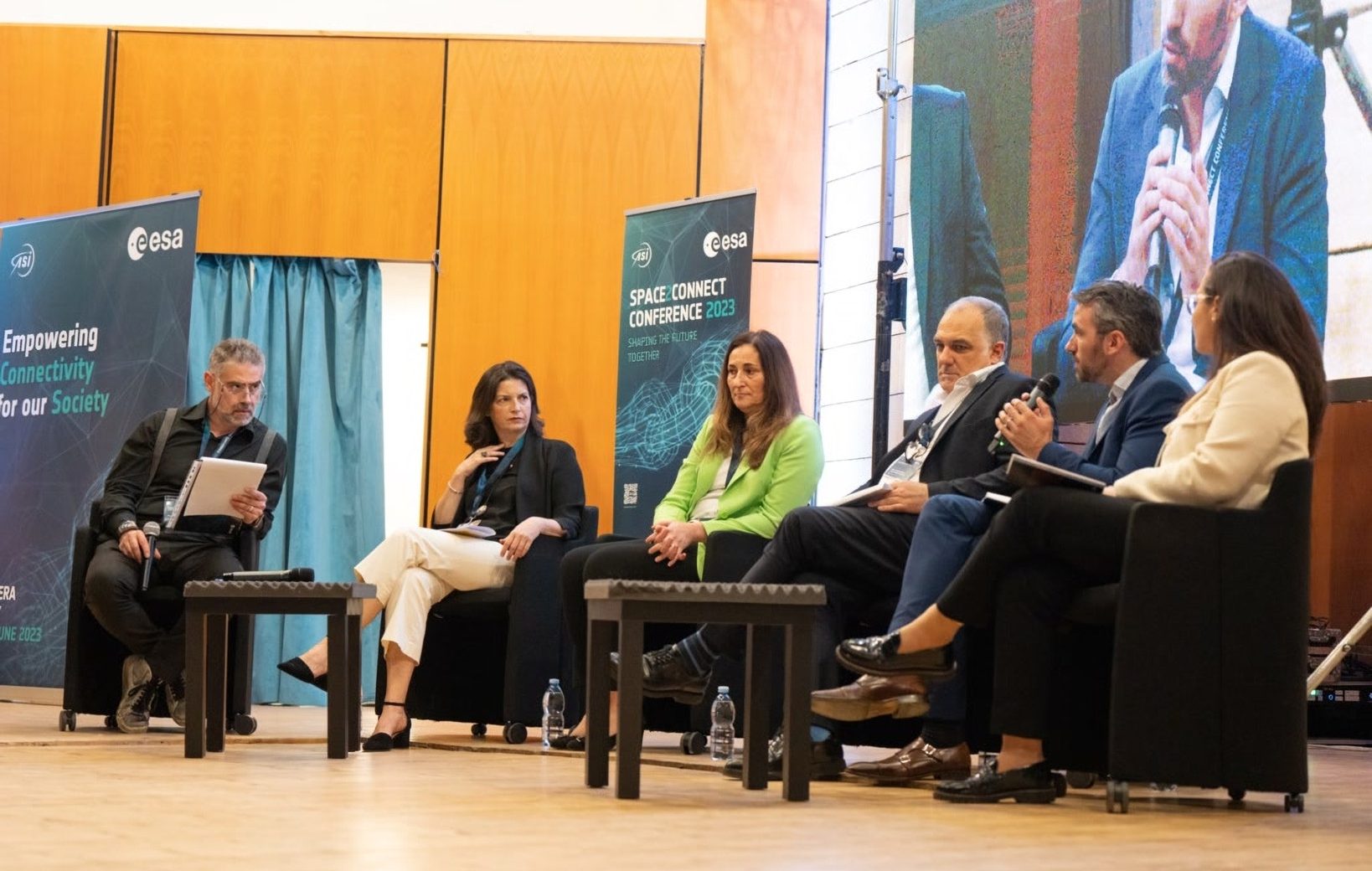
The European Space Agency’s Space2Connect Conference is an annual opportunity to explore the opportunities and challenges surrounding satellite telecommunications, and Darwin’s co-founder Daniela Petrovic was delighted to be invited this year as a guest speaker.

The European Space Agency’s Space2Connect Conference is an annual opportunity to explore the opportunities and challenges surrounding satellite telecommunications, and Darwin’s co-founder Daniela Petrovic was delighted to be invited this year as a guest speaker. The conference took place from 7 to 9 June 2023 in the ancient and beautiful Italian city of Matera, home to the Italian Space Agency’s centre of operations. Satellite communications play a central role in Darwin’s work. Our ubiquitous communications technology harnesses both satellite and terrestrial telecommunications to keep vehicles connected to the internet while travelling, even in areas that have patchy 4G or 5G coverage. Many of Darwin’s achievements were made possible by our partnership with the European Space Agency (ESA). The conference included interesting discussions from all corners of the satellite communications industry. One major focus of the Space2Connect conference was sustainability: how space-based technology can support sustainability efforts on Earth, and how organisations can use space responsibly, minimising issues such as space debris. On the second day of the conference, Darwin took part in the round table discussion ‘Space for a Green Transition and Resilience to Climate Impact’, where Daniela and other industry experts talked about the role of space in sustainability and disaster management. Points that were raised in the discussion included: While there’s plenty of public awareness about the greenhouse gas emissions of certain industries, such as transportation and electricity production, there are less discussed areas that nonetheless contribute significantly to climate change. For example, agriculture, wastewater treatment and manufacturing all produce significant greenhouse gas emissions. Improvements that reduce greenhouse gas emissions across an industry can make a real difference, particularly in these high-emission industries. In many cases, it’s already possible to make changes that can reduce emissions. For example, governments can encourage the use of low-emission modes of transport such as cycling or public transport, or can create incentives to switch from petrol-powered cars to electric vehicles. However, it’s also worth investing in alternative options such as better fuels, as a lack of funds or infrastructure may prevent some from making fundamental changes to the way they travel. It’s also important to consider where there’s still room for improvement. For example, the emissions of electric vehicles could be further reduced by generating more electricity using clean methods, or by researching low-emission materials that could be used in vehicle construction, as the manufacturing of steel and plastic creates greenhouse gases in large quantities. Darwin is helping with its work on autonomous public transport services. Self-driving vehicles have sustainability advantages over traditional vehicles and can help to fill in gaps in public transportation, reducing reliance on single-occupant cars. We’ve also published articles to increase awareness of the capabilities and efficient use of electric vehicles; take a look at our articles on long-distance driving in an electric car or how to make your car battery last longer. You can see a few photographs from Daniela’s visit below: Darwin Innovation Group is a UK-based company that provides services related to autonomous vehicles and communications. If you’re interested in working with us, take a look at our careers page. If you’d like to know how we can help your organisation make use of autonomous vehicles, contact us. You can also follow us on LinkedIn or Twitter.
Read moreless
1 6 7 8 9 10 29
Privacy Overview

We use cookies to gather anonymous statistics about how our website is being used. If you're okay with this, click 'Accept'. If you'd prefer to opt out, click 'Reject'.

News tags