NEWS

10 October 2023

Darwin at 5G DRIVE showcase

Darwin at 5G DRIVE showcase

On 5 October 2023, the 5G DRIVE showcase took place at the Satellite Applications Catapult, located at Harwell Science and Innovation Campus. Darwin was pleased to demonstrate at the event, alongside many other innovative organisations.

On 5 October 2023, the 5G DRIVE showcase took place at the Satellite Applications Catapult, located at Harwell Science and Innovation Campus. Darwin was pleased to demonstrate at the event, alongside many other innovative organisations. 5G DRIVE is a government-supported project bringing together the wisdom and expertise of organisations across the telecommunications industry. The project aims to make it easier, less costly and more secure to integrate public and private 5G networks, opening up new opportunities for the use of 5G technology. At the showcase, Darwin demonstrated its ubiquitous communications technology and the Darwin Autonomous Shuttle. It was great to welcome attendees aboard the shuttle! The showcase also featured a demonstration of small cell technology from our longstanding partner Virgin Media O2, and presentations and demonstrations from Cisco. Earlier in the year, Virgin Media O2 and Cisco launched a portable 5G network at the Darwin SatCom Lab. Darwin’s co-founder, Daniela Petrovic, enjoyed the event. ‘It was well attended by government and industry representatives, and David Owens, Virgin Media O2’s head of technical trials, has once again shown his ingenuity in keeping innovation moving in the UK,’ she said. The 5G DRIVE project is being extended for a further ten months, and we look forward to seeing all that it can achieve! Take a look at what we got up to at the recent #5G Drive showcase event, where we looked to the future of innovative #5G technology and private networks. @SciTechgovuk @5G_drive @cisco @wavemobileuk @uniofwarwick pic.twitter.com/T1XukGSJfJ— Virgin Media O2 News (@VMO2News) October 17, 2023 Darwin Innovation Group is a UK-based company that provides services related to autonomous vehicles and communications. If you’re interested in working with us, take a look at our careers page. If you’d like to know how we can help your organisation make use of autonomous vehicles, contact us. You can also follow us on LinkedIn or Twitter.
Read moreless

3 October 2023

ESA astronaut Tim Peake rides the Darwin Autonomous Shuttle

ESA astronaut Tim Peake rides the Darwin Autonomous Shuttle

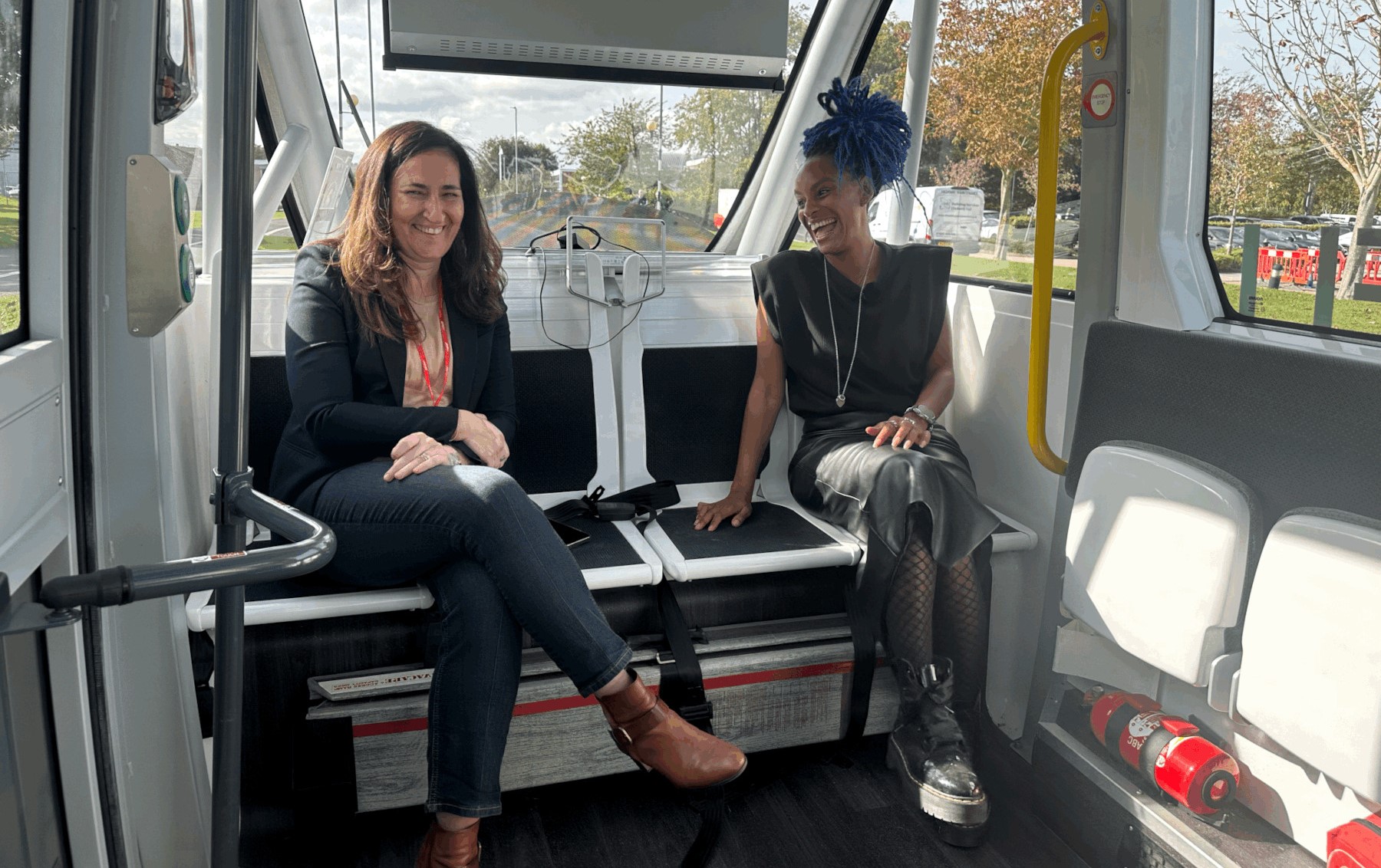
We were honoured to welcome British astronaut Tim Peake aboard the Darwin Autonomous Shuttle in May!

Tim has plenty of experience with high-tech vehicles from his time as a European Space Agency astronaut. In late 2015 he travelled on a Soyuz spacecraft to the International Space Station, where he spent six months. The Darwin Autonomous Shuttle couldn’t take him into space, of course, but we hope he enjoyed its self-driving capabilities as it took him around Harwell Science and Innovation Campus.

We were honoured to welcome British astronaut Tim Peake aboard the Darwin Autonomous Shuttle in May! Tim has plenty of experience with high-tech vehicles from his time as a European Space Agency astronaut. In late 2015 he travelled on a Soyuz spacecraft to the International Space Station, where he spent six months. The Darwin Autonomous Shuttle couldn’t take him into space, of course, but we hope he enjoyed its self-driving capabilities as it took him around Harwell Science and Innovation Campus. Tim was filming a segment for Secrets of Our Universe with Tim Peake, a Channel 5 documentary series about space. Specifically, he was looking at satellites and their applications on Earth. By making use of both satellites and terrestrial networks, the Darwin Autonomous Shuttle can remain connected almost anywhere, and it does this with the help of Darwin’s ubiquitous communications technology. To see the Darwin Autonomous Shuttle in action and learn more about satellites, you can watch the episode ‘Living in Space’. The episode will be on Channel 5 at 9pm on Tuesday 3 October. After airing, you’ll find it available for streaming on My5. Darwin Innovation Group is a UK-based company that provides services related to autonomous vehicles and communications. If you’re interested in working with us, take a look at our careers page. If you’d like to know how we can help your organisation make use of autonomous vehicles, contact us. You can also follow us on LinkedIn or Twitter.
Read moreless

19 September 2023

Darwin to present connectivity and transport solutions at Greencities Málaga

Darwin to present connectivity and transport solutions at Greencities Málaga

Based in Málaga, Greencities is an annual event looking at urban transformation and how cities can be navigated in more efficient, more sustainable ways. The 2023 event is taking place on 20 and 21 September, and Darwin will be there to present its solutions to fellow attendees.

Based in Málaga, Greencities is an annual event looking at urban transformation and how cities can be navigated in more efficient, more sustainable ways. The 2023 event is taking place on 20 and 21 September, and Darwin will be there to present its solutions to fellow attendees. Darwin Innovation Group is an innovative startup with offices in Málaga and the UK, focusing on improvements in the fields of connectivity and transportation. Our services include: Setting up autonomous vehicle services for cities, campuses or other organisations. Providing constant, reliable connectivity on the move by switching seamlessly between terrestrial and satellite networks. Data collection from vehicle fleets, which can be used to improve the services of public transportation networks, CAV operators, delivery drivers, insurers and more. Our Málaga team will be on hand at the Greencities event to present our products and answer any questions. We’re at position P14 in the main pavilion. We’re looking forward to seeing you! If you’d like to contact us before, during or after the show, feel free to email us at [email protected] Darwin Innovation Group is a UK-based company that provides services related to autonomous vehicles and communications. If you’re interested in working with us, take a look at our careers page. If you’d like to know how we can help your organisation make use of autonomous vehicles, contact us. You can also follow us on LinkedIn or Twitter.
Read moreless

5 September 2023

The Apollo spacecraft

The Apollo spacecraft

This is the second in our series of posts about the Apollo moon missions of the 1960s and 1970s: the first and, so far, the only time humans have been to the moon. In today’s post, we’re looking at the Apollo spacecraft, the roles of the people aboard and how the Apollo astronauts were able to return safely to Earth.

This is the second in our series of posts about the Apollo moon missions of the 1960s and 1970s: the first and, so far, the only time humans have been to the moon. In today’s post, we’re looking at the Apollo spacecraft, the roles of the people aboard and how the Apollo astronauts were able to return safely to Earth. For more about the Apollo moon missions, take a look at the first post in our Apollo series, which talks about how many people have been to the moon and how they survived on its surface. Components of the Apollo spacecraft The Apollo spacecraft consisted of three main components: the command module, the service module and the lunar module. The service module was attached to the back of the command module for most of the mission, so these two modules essentially functioned as a single module: the command and service module. The command module was where the crew lived, ate and slept in space. It was a little cramped, with only six cubic metres of living space to accommodate three people for the approximately three days it took to reach the moon, but being able to float enabled the crew to make full use of that space. To make sure they didn’t float around while sleeping, the crew slept in ‘sleep restraints’, which were essentially sleeping bags tethered in place. The service module, attached to the back of the command module, provided essentials such as fuel, oxygen and electricity. It also contained the main propulsion system. If something went wrong in the service module, you were in trouble, but it might be possible to recover with some ingenuity; more on that when we reach Apollo 13. The lunar module, also called the lunar lander, was the part of the spacecraft that would actually land on the moon. It consisted of two main sections: the descent stage, which was designed to land safely on the moon’s surface, and, on top of that stage, the ascent stage, which contained the flight instruments and crew cabin. Below, you can see a picture of the lunar module sitting on the moon during Apollo 14. The descent stage is the part with legs, covered with crinkly golden material. This material reflects heat from the sun to prevent the spacecraft from overheating; you can read more about this in our post on the problems satellites face. Something you might notice about the lunar module is that it doesn’t look like traditional ideas of a rocket or spaceship; it’s not sleek and it’s not aerodynamic. Simply put, this is because it doesn’t need to be. It doesn’t detach from the command module and start flying by itself until it’s in the vacuum of space, where being aerodynamic isn’t a concern. The purpose of an aerodynamic design is to reduce air resistance, but there’s no air resistance in a vacuum. The lunar module’s descent stage acted as a launch pad for the ascent stage when leaving the moon, so the astronauts would take off in the ascent stage to return to the service module, leaving the descent stage behind. Again, as the moon’s atmosphere is extremely thin, the ascent stage doesn’t need to be aerodynamic in order to take off. The lunar module descent stages from the six Apollo moon landings are still on the moon to this day. The crew on Apollo missions Each crewed Apollo mission to land on the moon carried three astronauts: the commander, the lunar module pilot and the command module pilot. However, only the commander and lunar module pilot would actually visit the moon’s surface in the lunar module. As you might expect, the commander was in overall charge of the mission. They were responsible for looking after the spacecraft and the crew, and would also perform some manual flying tasks; more on that in a moment. From the name, you might expect the lunar module pilot to be in charge of the lunar module’s manual flight controls, but in fact the person responsible for manually flying the lunar module was the commander. The lunar module pilot managed the flight computer, which was responsible for most of the lunar module’s journey through space. When the commander took over control for delicate operations such as landing, the lunar module pilot would monitor the instruments and keep the commander informed of anything they might need to know for navigation. The command module pilot would remain in the command module, orbiting the moon and making observations, while the commander and lunar module pilot went down to the moon’s surface in the lunar module. When the lunar module returned, the command module pilot would dock with it, allowing the commander and lunar module pilot to re-enter the command module. As the command module pilot wouldn’t step onto the moon, their role might seem less flashy than the roles of their fellow crew members, but they ranked higher than the lunar module pilot and played a crucial part in ensuring everyone could get home safely. How did Apollo missions come back to Earth? The command module was the only part of the Apollo spacecraft that would return to Earth, so it was designed to survive falling through the atmosphere and protect the astronauts inside, rather than burning up due to air friction. It also had parachutes to slow its fall, allowing the crew to land safely in the ocean, where the command module would float until the astronauts could be picked up by ship. Decades later, in 2022, Artemis I’s Orion spacecraft landed in a similar way: the crew module deployed its parachutes, came down in the Pacific Ocean and floated until it was retrieved by ship. However, Orion came back into the atmosphere in a slightly different way, using a skip entry. This means the spacecraft essentially dipped into the atmosphere and then bounced off it before coming back down, like a skipping stone, slowing its acceleration and giving it more control over where it would land. An interesting element of the Apollo command module, mentioned in NASA’s Command Module Overview, is that it’s designed so it can be returned to Earth even by a single astronaut. In other words, the command module’s design takes into account the possibility that, for example, the astronauts on the moon might be unable to return for some reason. In that case, the command module pilot would still be able to get back to Earth, rather than being stranded in lunar orbit. Fortunately, this functionality was never required; all the Apollo astronauts who visited the moon’s surface were able to return safely to the command module and come back to Earth. In our later Apollo posts, we’ll be looking in more detail at individual crewed Apollo missions, starting with Apollo 7 and 8. These early missions laid crucial groundwork for the later moon landings. Cover image: USSR Academy of Sciences Lunar module image: NASA Darwin Innovation Group is a UK-based company that provides services related to autonomous vehicles and communications. If you’re interested in working with us, take a look at our careers page. If you’d like to know how we can help your organisation make use of autonomous vehicles, contact us. You can also follow us on LinkedIn or Twitter.

Read moreless

22 August 2023

Looking back at the Apollo moon landings

Looking back at the Apollo moon landings

The success of Artemis I means we’re looking at the exciting prospect of returning humans to the moon. If all goes to plan, humans may step onto the moon’s surface again as early as 2025, during the planned Artemis III mission.

With the moon once more within reach, it feels like an appropriate time to reflect on the last time humans really connected with it. This article is the first of a series looking at humanity’s first steps on the moon.

The success of Artemis I means we’re looking at the exciting prospect of returning humans to the moon. If all goes to plan, humans may step onto the moon’s surface again as early as 2025, during the planned Artemis III mission. The Artemis moon missions are building on what we learnt from the Apollo moon missions in the 1960s and 1970s, and the naming of the Artemis programme reflects that. Artemis was the Greek goddess of the moon, making the name particularly apt, but she was also the twin sister of the sun god Apollo. With the moon once more within reach, it feels like an appropriate time to reflect on the last time humans really connected with it. This article is the first of a series looking at humanity’s first steps on the moon. In this introductory post, we’ll talk about how many people have been to the moon and how they survived on its surface. How many people have walked on the moon? There have been six crewed moon landings in total, all of which were part of NASA’s Apollo programme: Apollo 11, Apollo 12, Apollo 14, Apollo 15, Apollo 16 and Apollo 17. To date, only 12 people have stepped onto the surface of the moon: two astronauts from each of the listed Apollo moon landings. All of them were white American men, and all of them performed their moonwalks between July 1969 and December 1972: the span of just three and a half years, over half a century ago. Including the 12 who have walked on it, 24 people in total have travelled to the moon. Again, all of these journeys took place during the Apollo programme. Each of the six moon landings included a third crew member who orbited the moon without landing, and the crewed missions Apollo 8, Apollo 10 and Apollo 13 also visited the moon, although they didn’t land. Three astronauts – Jim Lovell, John Young and Gene Cernan – have travelled to the moon twice, which is why these nine missions with three-person crews add up to 24 people, rather than 27. Artemis II, scheduled to launch and travel around the moon next year, is expected to add four more people to the number of moon visitors: Victor Glover, Jeremy Hansen, Christina Koch and Reid Wiseman. How did Apollo astronauts survive on the moon? There were a lot of challenges to overcome in order for the astronauts to be able to survive and explore comfortably on the moon. For example, their spacesuits needed to be pressurised, as humans cannot survive in a vacuum. Here are a few of the other challenges that the Apollo astronauts’ spacesuits needed to address: Perhaps most obviously, humans need to breathe oxygen, which is not readily available on the moon. You may have noticed that, in photographs and videos of the moon landings, each astronaut seems to have a large backpack attached to the back of their spacesuit. This backpack is a portable life support system supplying them with oxygen from a tank. If necessary, the tank could be topped up from the lunar lander’s oxygen reserves. Humans also breathe out carbon dioxide, which will build up to dangerous levels in the confined environment of a spacesuit if it’s not removed. The portable life support system filtered the air supply inside the suit through a lithium hydroxide cartridge. The lithium hydroxide reacted with carbon dioxide to create lithium carbonate and water, removing the carbon dioxide from the air supply inside the suit. Without the protection of Earth’s atmosphere, objects on the moon can experience extreme temperatures, ranging from over 100°C in direct sunlight to below -100°C at night. To protect against these temperatures, the astronauts’ spacesuits needed to be extremely well insulated. However, the spacesuit also needed to prevent the astronaut from overheating. Without any means of cooling down, the astronaut’s body heat and the heat generated by the life support system would build up to potentially dangerous levels inside the spacesuit. Beneath their outer spacesuits, Apollo astronauts wore full-body garments made up of flexible fabric-covered tubes; you can see an example here on the National Air and Space Museum’s website. Water was cooled in the portable life support system and pumped through these tubes to keep the astronauts cool. In addition to using water for cooling purposes, the spacesuit had a water bag for the astronauts to drink from during excursions. The bag had a valve to ensure that water only came out when it was actively being drunk, preventing liquid from leaking into the spacesuit. In later posts, we’ll talk about the individual manned Apollo moon landings, from Apollo 11 to Apollo 17. We’ll also take a moment to look back at Apollo 13, which didn’t manage to land on the moon but was still a significant mission in many ways, and we’ll reflect on how Apollo 7 to Apollo 10 laid the foundations for the landings to take place. The Apollo missions were a fascinating achievement, so we’re looking forward to delving deeper into them, and we hope you enjoy coming along for the ride. The next post in our Apollo series will take a closer look at the Apollo spacecraft and the roles of the crew members aboard. We hope to see you there! Cover image: NASA Darwin Innovation Group is a UK-based company that provides services related to autonomous vehicles and communications. If you’re interested in working with us, take a look at our careers page. If you’d like to know how we can help your organisation make use of autonomous vehicles, contact us. You can also follow us on LinkedIn or Twitter.
Read moreless
1 5 6 7 8 9 29

News tags