NEWS

15 June 2021

What will 6G be like?

What will 6G be like?

We’re only just starting to see significant rollouts of 5G, but there is already a lot of buzz around 6G. Rodrigo Barreto, Darwin’s lead architect, takes a look into this looming mobile generation in this post to see what all this buzz is about.

We’re only just starting to see significant rollouts of 5G, but there is already a lot of buzz around 6G. Rodrigo Barreto, Darwin’s lead architect, takes a look into this looming mobile generation in this post to see what all this buzz is about. What makes 6G new? All new generations of mobile communications start with setting a vision which is not a simple extension of the current generation. An extension would be a .5 release. For example, HSPA was dubbed 3.5G and LTE Advanced is now sometimes called 4.5G. To be considered a new generation, the vision needs to bring to the table new use cases which are underpinned by social and economic needs as well as being supported by technology advancements. In the past, the vision for new generations of mobile communications was quickly translated into key performance indicators (KPIs). For 5G, famously, the KPI-based promises were that, compared to 4G networks, 5G networks would have data rates between 10 times and 100 times faster, with latencies up to 10 times smaller and 500 times the device density. These were deemed necessary to underpin use cases of enhanced mobile broadband, ultra-reliable low-latency communications and a massive internet of things (IoT). For 6G, there is a clear effort to step slightly away from pure KPI-driven objectives and increase the focus on societal needs. Such an approach is captured in seminal whitepapers published by the likes of Samsung, the Institution of Engineering and Technology, the 6G Innovation Centre of the University of Surrey, the Next Generation Mobile Network alliance, and EU’s project Hexa-X, to name a few. If you are interested in reading these whitepapers, the links are provided below: Samsung: 6G: The Next Hyper-Connected Experience for All IET: 6G for Policy Makers 6GIC: 6G Wireless: A New Strategic Vision NGMN: 6G Drivers and Vision Hexa-X: 6G Vision, Use Cases and Key Societal Values What these papers have in common is a vision of technology in the service of society, helping in the achievement of sustainable development goals. They also take into account, to different degrees, goals related to economic development, environment, and commercialisation and operations of next-generation services. What will 6G be used for? The use cases envisaged to be supported by 6G communications are very exciting. Below is a glimpse of what is to come: Holographic-type communications (HTC). HTC will allow remote users to be projected as a 3D holographic presence at a separate site, in real time, possibly amongst physically present people. Uses for this are wide and varied, ranging from remote troubleshooting and repair applications to training and education, real-time communication, messaging, immersive gaming and entertainment. Extended reality (ER or XR). ER will utilise 3D objects and artificial intelligence (AI), combining real and virtual environments. This will bring together advanced capabilities of virtual reality, augmented reality and mixed reality. Tactile internet. With immersive audiovisual feeds provided by ER or HTC streaming, together with haptic sensing data, a human operator will be able to remotely control machinery in a place surrounded by biological or chemical hazards. Remote robotic surgery could be carried out by doctors from hundreds of miles away. Multi-sense experience. This will extend the tactile internet to enable users to experience real-time interactive, multisensory communication, incorporating hearing, sight, taste, smell and touch. Digital replicas. These are also called digital twins, and they create a digital copy of people, places, systems or objects. Theses digital replicas are useful for computational simulation and analysis of real physical objects of all sizes, saving on costs and time. Collaborative robots (cobots). Cobots are robots that are capable of collaborating with humans. This collaboration is supposed to enhance human abilities in a safe way. Intelligence as a service. This is AI as a service utilising distributed computing resources across the cloud, mobile edge and end devices, and cultivating communication-efficient machine learning (ML) training and inference mechanisms. For example, a humanoid robot would be able to offload its computational load for computer vision, simultaneous localisation and mapping, face and speech recognition, natural language processing, motion control etc. towards edge computing resources, in order to improve accuracy, prolong battery life, and become more lightweight by removing some embedded computing components. Intelligent transport and logistics. By 2030 and beyond, millions of autonomous vehicles and drones will provide safe, efficient and green movement of people and goods. Enhanced onboard communications. 6G is expected to be an integrated system of terrestrial networks, satellite constellations and other aerial platforms to provide seamless 3D coverage, which offers high-quality, low-cost and global-roaming onboard communication services. Global ubiquitous connectivity. By leveraging multiple layers of connectivity (terrestrial, unmanned air vehicles, high-altitude platforms, low and medium Earth orbit satellites and geostationary satellites), as well as integrating with previous-generation communication systems, 6G will be able to provide global ubiquitous connectivity, including areas where it has previously never been economically viable to implement communications infrastructure. At Darwin, we are very encouraged by the fact that three of the use cases mentioned (intelligent transport and logistics, enhanced onboard communications, and global ubiquitous connectivity) are already at the heart of the services and solutions that we have been developing. What is needed for 6G? The development of 6G will be fuelled by advancements of existing technology, and by technologies that don’t yet exist or have just about been demonstrated in laboratories. These include: Pervasive intelligence. Artificial intelligence, and more specifically machine learning, will be used in multiple areas of 6G networks. AI (and ML) use will include physical layer optimisation, medium access resource allocation and control, security, performance management, operations and preventive maintenance. Reconfigurable intelligent surfaces. These are a category of programmable and reconfigurable material sheets that are capable of adaptively modifying their radio-reflecting characteristics. When attached to environmental surfaces, e.g. walls, glass, ceilings etc., RIS enables the conversion of parts of the wireless environment into smart reconfigurable reflectors, known as smart radio environment (SRE). These can be exploited for a passive beamforming that can significantly improve communication at low costs of implementation and power consumption. Non-terrestrial communications. Though non-terrestrial network (NTN) integration with terrestrial mobile communications is part of the 5G vision, in 6G it will be central to building a three-dimensional network that leverages multi-connectivity (with base stations at ground, aerial and orbit levels) for service continuity, traffic offloading and backhauling. Terahertz communications. The data rates, latency, reliability and synchronicity required by 6G use cases will demand wide spectrum bandwidth which will be found on the terahertz spectrum. The terahertz spectrum sits between millimetre waves and free optical communications and hasn’t yet been fully explored. Its development will require advancements in network architecture and in transceiver design, propagation and channel modelling. It will also require studies supporting regulation for health and safety. Quantum computing and communications. Pervasive use of machine learning in 6G will require superior computing capabilities at different points in the network. Quantum computing, leveraging new materials such as graphene-based semiconductors, will deliver these computing capabilities. Quantum behaviour, such as entanglement and optical switching, will also be leveraged for ultra-fast, ultra-low-latency communication. Extreme massive MIMO. MIMO stands for ‘multiple-input, multiple-output’. 6G base stations will transmit and receive data using extremely massive numbers of antennas. Metasurface materials will underpin this by creating the required low cost and low power requirement conditions for mass-scale industrialisation. Blockchain and distributed ledger technology. Integration of blockchain into 6G will enable the network to monitor and manage resource utilisation and sharing efficiently. Ambient backscatter communications. These will leverage existing radio frequency signals, such as radio, television and legacy mobile telephony, to transmit data without a battery or power grid connection. Device antennas will pick up an existing signal and convert it into tens to hundreds of microwatts of electricity. That power will be used to modify and reflect the signal with encoded data. When is 6G coming, and how is it being developed? With so much at stake in terms of developing technology leadership and reaping the benefits that the new use cases of 6G will deliver, it is no surprise to see substantial geopolitics at play. Having been isolated in its ability to sell 5G technology to developed countries, China seems to be doubling down on 6G research and claims to have already filed more than 35% of the essential patents for 6G. Not to be left behind, the United States is launching a coordinated effort with industry and academia, spearhead by the Alliance of Telecommunications Industry Solutions (ATIS) through its Next G Alliance, and has recently announced a $4.5 billion joint investment with Japan for development of 6G technology.  Europe has launched several projects under its framework for funding of research and innovation, and has recently announced it will invest €900 million into 5G deployment and 6G research. Individual European countries also have their own programmes, with Germany pledging investments of €700 million in 6G research, and Finland and India announcing collaboration in 6G research. Korea, another leading country for mobile technologies, has announced investments equivalent to $180 million in 6G technology research. But a next-generation mobile technology does not get developed by a country or bloc in isolation. Strong imperatives around economies of scale and interconnection dictate that a new generation of mobile communications be developed in a collaborative manner and following common standards. This process starts with the International Telecommunication Union (ITU) developing the vision and a common set of objectives and principles, and the 3GPP taking on the role of developing the technical requirements and standards. The ITU has already formed the ITU-R 6G Vision Group, which is working on the initial drafts of the report ‘IMT towards 2030 and beyond (6G)’. At the level of 3GPP, it is anticipated that study items for 6G will start to be proposed from 2022 and will be part of Release 19 packet approval sometime in 2023. In all likelihood, concrete 6G standardisation work will start from 3GPP Release 20, and it is anticipated that initial trial deployments of 6G will happen from 2028. Rodrigo Barreto, Darwin Lead Architect Darwin Innovation Group is a UK-based company that provides services related to autonomous vehicles and communications. If you’re interested in working with us, take a look at our careers page. If you’d like to know how we can help your organisation make use of autonomous vehicles, contact us. You can also follow us on LinkedIn or Twitter.
Read moreless

3 June 2021

Aviva and Darwin announce five-year strategic partnership

Aviva and Darwin announce five-year strategic partnership

Aviva plc and Darwin Innovation Group are pleased to announce that they are entering into a five-year strategic partnership, beginning with collaboration on an exciting autonomous vehicle trial.

An autonomous shuttle controlled by 5G and satellite connectivity will transport members of the public around the Harwell Science and Innovation Campus in Oxfordshire, with a second shuttle to be introduced later The electric shuttles, which do not have a steering wheel, will operate 24/7 to capture data in different light and weather conditions Aviva will use data from the trial to help build the future model of motor insurance The trial builds on the October 2020 launch by O2 and Darwin Innovation Group of the UK’s first 5G and satellite communications commercial laboratory Aviva plc and Darwin Innovation Group are pleased to announce that they are entering into a five-year strategic partnership, beginning with collaboration on an exciting autonomous vehicle trial. Darwin is trialling an autonomous shuttle at the Harwell Science and Innovation Campus in Oxfordshire. Created by Navya, this vehicle, controlled by 5G and satellite connectivity, will be able to pick passengers up, transport them around the campus and drop them off at their destination, all without the involvement of a human driver. A second shuttle is expected to be added in the second year of operation. The trial is supported by the European Space Agency and UK Space Agency. The electric shuttles will operate 24/7, which will allow the capture of data in different light and weather conditions, and will transmit this data via 5G and satellite channels. The vehicles will have a high level of automation – level 4 autonomy, according to SAE International’s levels of driving automation – and they do not have a steering wheel. Darwin has carefully mapped out the campus and provided the shuttles with all the information they will need to navigate the area. The shuttles will be able to communicate with each other, and will be well equipped with sensors, so they can navigate without obstructing each other and can react to any unexpected obstacles. Autonomous vehicles offer the potential to dramatically improve road safety and revolutionise the UK’s mobility system.  However, as the technology within vehicles evolves and we draw closer to having fully autonomous vehicles on our roads, there will be new risks and vehicle uses that insurers will have to assess when underwriting these vehicles. Being involved in the testing and development phases of this trial means Aviva is well placed to react to the increasing automation of vehicles on UK roads. The trial will showcase the application of connected autonomous vehicles and allow Aviva to build its first comprehensive insurance model for this type of vehicle, which will evolve as the trial progresses. The trial with Aviva builds on the October 2020 launch by O2 and Darwin Innovation Group of the Darwin SatCom Lab, the UK’s first commercial laboratory for 5G and satellite communications, situated at the Harwell Science and Innovation Campus. The laboratory enables companies like Aviva to explore next-generation connectivity solutions for connected and autonomous vehicles using both 5G and satellite communications. Nick Amin, Chief Operating Officer at Aviva, said: “With this trial, we’re able to be there right from the start of the real-life application of autonomous vehicles operating on public roads, which will change not only our relationship with these vehicles but, more fundamentally, how we insure them. Autonomous vehicles could change the face of motor insurance within a decade. Through having access to the data from this trial, we can understand today the kinds of things we’ll have to consider in the future to keep passengers, pedestrians and all other road users safe when driverless technology hits public roads.” Tom Pitney, Motor Underwriter at Aviva, said: “I’m thrilled to be involved in this trial, which will be the first of its kind in the UK. The vehicles we insure are constantly evolving and fully autonomous vehicles are on their way to our roads. This will result in a huge shift in the way we underwrite and price for these risks. Being involved at the outset enables us to better understand the future of mobility and ensure that we have a product ready to insure the vehicles of the future. Most importantly, this demonstrates our core purpose of ‘with you today for a better tomorrow’.” Daniela Petrovic, Delivery Director at Darwin, said: “For any emergent market to be a success, we need to create an ecosystem of companies who share a vision for innovation and are willing to expand their core competency into something new. Emergent markets are usually found at the intersection of industries, and that is why, for the CAV ecosystem to work, we must gather actors from multiple industries to work together. The Darwin team are delighted to have Aviva as a partner in this ecosystem, jointly creating new insurance models and enabling CAVs to become mainstream in the UK market.” Sergio Budkin, Director of Business Products at O2, said: “It’s encouraging to see the CAV ecosystem grow through this strategic partnership between Darwin Innovation Group and Aviva. We’re also delighted to see companies putting theory into practice by launching trials using CAVs and building upon the work O2 kicked off in October last year through the launch of the Darwin SatCom Lab, which offers companies access to O2-customised autonomous vehicles in order to test proofs of concept.” Darwin Innovation Group is a UK-based company that provides services related to autonomous vehicles and communications. If you’re interested in working with us, take a look at our careers page. If you’d like to know how we can help your organisation make use of autonomous vehicles, contact us. You can also follow us on LinkedIn or Twitter.
Read moreless

1 June 2021

A brief introduction to antennas

A brief introduction to antennas

Over the last few weeks, we’ve been talking a lot about communications technology, both terrestrial and satellite-based. Terrestrial and satellite technology play different roles in communications, but they both involve radio waves, which means they both require antennas to transmit and receive those radio waves. Your mobile phone contains at least one antenna; it’s likely to contain more.

Dr Soheyl Soodmand, our senior RF and antenna architect, has written a piece to share his expertise on the subject of antenna technology. Please enjoy this article on how antennas work, and on some of the different types of antenna relevant to our work at Darwin.

Over the last few weeks, we’ve been talking a lot about communications technology, both terrestrial and satellite-based. For example, take a look at our articles on the history of mobile generations, or on satellite applications. Terrestrial and satellite technology play different roles in communications, but they both involve radio waves, which means they both require antennas to transmit and receive those radio waves. Your mobile phone contains at least one antenna; it’s likely to contain more. Pectoral bodybuilding program at home and in the gym where to buy roids bodybuilding and body fat - budo no nayami. Dr Soheyl Soodmand, our senior RF and antenna architect, has written a piece to share his expertise on the subject of antenna technology. Please enjoy the below article on how antennas work, and on some of the different types of antenna relevant to our work at Darwin. - Webster’s Dictionary defines an antenna as ‘a usually metallic device (as a rod or wire) for radiating or receiving radio waves’. The Institute of Electrical and Electronics Engineers (IEEE) defines the antenna as ‘a means for radiating or receiving radio waves’. The latter is a better definition, as modern antennas make use of different materials and are implemented in diverse shapes. When we informally refer to antennas, we are most commonly thinking of a set of three distinct elements: the antenna, which transmits and receives the radio waves to/from free space the receiver or transmitter, which transforms these waves into electrical signals the intermediary structure or waveguide or transmission line, which transports the waves between the other two elements Antennas are designed to work in specific radio frequencies, and the antenna does not transmit or receive radio waves outside this operating frequency range. For wireless communication systems, the antenna is one of the most critical components. A good antenna design can relax system requirements and improve overall system performance. The antenna serves to a communication system the same purpose that eyes and eyeglasses serve to a human. Some famous antenna types include wire, aperture, microstrip, array, reflector, lens etc. To describe the performance of an antenna, it is necessary to consider various parameters: radiation pattern, radiation power density, radiation intensity, beamwidth, directivity, efficiency, gain, beam efficiency, bandwidth, polarisation, input impedance, radiation efficiency, vector effective length, temperature etc. For multi-input antennas and array antennas other parameters, such as isolation, need to be considered. A description of these parameters is beyond the scope of this article, but the list should give the reader an idea of the complexity involved in analysing antenna options to identify the optimal solution for a given application. In the case of Darwin’s work, antennas are mounted in vehicles for communication with mobile base stations and with satellites. To optimise transmission and reception of radio waves, there is a need to focus transmission and reception of waves between the vehicle and the cellular tower or satellite in space; this is achieved through a technique called beamforming. Because there is movement relative to vehicle and satellite or cellular tower coordinates, the radio wave beams need to be constantly realigned; this is achieved through a technique called beamsteering. Finally, to improve aerodynamics and preserve the aesthetics of vehicles, there is a preference for antennas which are either flat or able to conform with the roof surface of the vehicle. Three main technological options have been identified for low-profile antennas: metamaterial antennas, lens antennas and phased array antennas. Metamaterial antennas: A metamaterial is a material that gains its properties from its structure rather than directly from its composition. Metamaterials have unique properties that are not found in natural materials. Curiously, the most common implementation of metamaterials leverages liquid crystal to individually tune thousands of irradiating elements, in a similar way to technology used in LCD televisions. Lens antennas: A lens antenna uses the convergence and divergence properties of a lens to transmit and receive signals. These antennas consist of a small feed antenna followed by a lens made of dielectric material, which manipulates electromagnetic waves. Phased array antennas: Phased array antennas, as the name suggests, can be termed as an antenna array. What makes them unique is their ability to change the shape and direction of the radiation pattern without physically moving the antennas. This is achieved by transmitting signals of equal frequency from all the individual elements in the array with a certain phase difference/shift between them. Darwin is following developments in antenna technology very closely to select the most fitting options for our converged satellite and mobile solution. Dr Soheyl Soodmand, Senior RF and Antenna Architect Darwin Innovation Group is a UK-based company that provides services related to autonomous vehicles and communications. If you’re interested in working with us, take a look at our careers page. If you’d like to know how we can help your organisation make use of autonomous vehicles, contact us. You can also follow us on LinkedIn or Twitter.
Read moreless

18 May 2021

The applications of satellite technology

The applications of satellite technology

There are over 3,000 manmade satellites currently operating around Earth, but what are they actually being used for? Today, we’re talking about satellite applications.

There are over 3,000 manmade satellites currently operating around Earth, but what are they actually being used for? Today, we’re talking about satellite applications. Earth observation satellites Some satellites are launched into space in order to get a better view of Earth. These satellites are used for purposes such as monitoring weather, mapping terrain and aerial photography. They often help to monitor the environment; earth observation satellites can measure air quality, ocean salinity, ice thickness and crop health, and can track changes in vegetation or coastlines. Google Earth is a particularly well-known illustration of the power of satellite imaging. It uses satellite photography to create an intricate aerial map of the world, with finer details becoming visible as the user zooms in. The images have been taken by different satellites at different times and are combined to create an impression of seamlessness. It’s possible to zoom out far enough to see the entire Earth suspended in space, from a distance of tens of thousands of kilometres. Earth observation satellites can be used to aid in the response to disasters. Infrared sensors allow satellites to detect and track the spread of wildfires, enabling governments to respond swiftly and warn those who may be in harm’s way; NASA has an article on this. Satellites have also been used to monitor oil spills and volcanic eruptions. As more powerful equipment would be required to photograph or monitor Earth from further away, satellites used for Earth observation purposes are often in low orbits (also called low Earth orbit, or LEO), although some are maintained at higher altitudes. For more on the advantages and disadvantages of having satellites at certain altitudes, take a look at our previous post on the different types of satellite orbit. Navigation satellites Satellite navigation systems have become a part of daily life. If you use satnav while driving, or pull out your phone to check your position on the map, it’s easy to forget that you’re receiving signals from space. The US Space Force’s Global Positioning System (GPS) relies on a network of 31 satellites in medium Earth orbit (MEO), at an altitude of just over 20,000 kilometres. The first GPS satellite was launched in 1978. This system was originally created for the use of the US military, but it’s now so widely used that people often call any satellite navigation system a GPS. How does GPS work? The satellites in the network are sending out radio signals constantly, telling us two things: where the satellite is, and what time the signal was sent. A GPS receiver, such as the one in your phone, listens out for these signals. When it receives a signal, it checks the difference between the time the signal was sent and its own internal clock. Because the signals travel in a straight line at a predictable speed (the speed of light), this tells your phone exactly how far it is from the satellite. Of course, knowing how far you are from one satellite doesn’t necessarily help much. If you’re 10,000 kilometres from Peru, you could be in the United Kingdom, New Zealand or Tunisia. Because of this, GPS receivers narrow down their location by using signals from multiple satellites. If you’re about 10,000 kilometres from Peru and Cambodia and South Africa, there’s a good chance you’re in the United Kingdom. In order to pin down your location and altitude, your phone needs information from at least four satellites, so the orbits of the GPS satellites are calculated to make sure there are always at least four in view from any location on Earth. There’s a strange and fascinating problem involved in the way GPS works. According to Einstein’s general theory of relativity, time moves more slowly in areas of high gravity. This means that time runs faster on the satellite than it does for your phone. Why don’t the satellites fall out of sync with Earth-based clocks, meaning that it’s impossible to calculate how much time has passed since a signal was sent, and therefore impossible to calculate how far you are from a satellite? Fortunately, the system takes that into account. The clocks aboard the satellites are designed to run very slightly slower than normal clocks, making up for the time difference between Earth and their orbit. If you’re interested in learning more about GPS and relativity, Professor Richard W Pogge of Ohio State University wrote a piece on the subject in 2017: ‘Real-World Relativity: The GPS Navigation System’. Communications satellites We work with communications at Darwin, so naturally we’re interested in communications satellites. These are satellites that receive signals and transmit them elsewhere. For example, how does satellite television work? An Earth-based station transmits signals – the visuals and sounds of a television programme – to a satellite in orbit. This satellite amplifies the signals and returns them to Earth, where your satellite dish picks them up and decodes them. The specific area a satellite can serve depends on its orbit, but, in theory, satellites can send signals to anywhere on the Earth’s surface. This means that areas without the infrastructure for terrestrial or cable television may still be able to receive satellite television signals. Similarly, 5G has remarkable potential, but you can’t make use of it if you’re in an area without any 5G towers, or if a disaster has destroyed the local communications infrastructure. A satellite phone, on the other hand, can be used almost anywhere on the planet.  Mountaineers sometimes carry satellite phones or satellite-linked emergency beacons, meaning they can get in contact with rescue services if something goes wrong in a remote spot. Satellite communications aren’t always the best tool for a task. To use a satellite phone effectively, you’ll need a clear line of sight to the satellite. This means that satellite phones tend to be less useful than traditional mobile phones indoors or in built-up areas, unless there’s a nearby antenna to relay the signal. Currently, satellite phones are also more expensive to buy and use than traditional mobile phones. However, satellite signals can reach places that terrestrial networks can’t, meaning that satellites provide a valuable complement to terrestrial communications technology. There are other types of artificial satellite we haven’t touched on here. For example, space stations are a type of satellite, and Earth observation satellites aren’t the only sort of observation-focused satellite; some satellites, such as the Hubble Space Telescope, exist to research or photograph space. Hopefully, though, this article has given an overview of why satellites are such a useful tool. From their high-up vantage point, satellites have the ability to connect the world. At Darwin, we’re making use of that to achieve our goal of ubiquitous communications. Darwin Innovation Group is a UK-based company that provides services related to autonomous vehicles and communications. If you’re interested in working with us, take a look at our careers page. If you’d like to know how we can help your organisation make use of autonomous vehicles, contact us. You can also follow us on LinkedIn or Twitter.
Read moreless

4 May 2021

Satellite communications: what’s the difference between LEO, MEO and GSO?

Satellite communications: what’s the difference between LEO, MEO and GSO?

We’ve been talking a lot about terrestrial communications technology recently. However, that’s not the only kind of communications technology we work with at Darwin. Today, we’re discussing different types of satellite orbit.

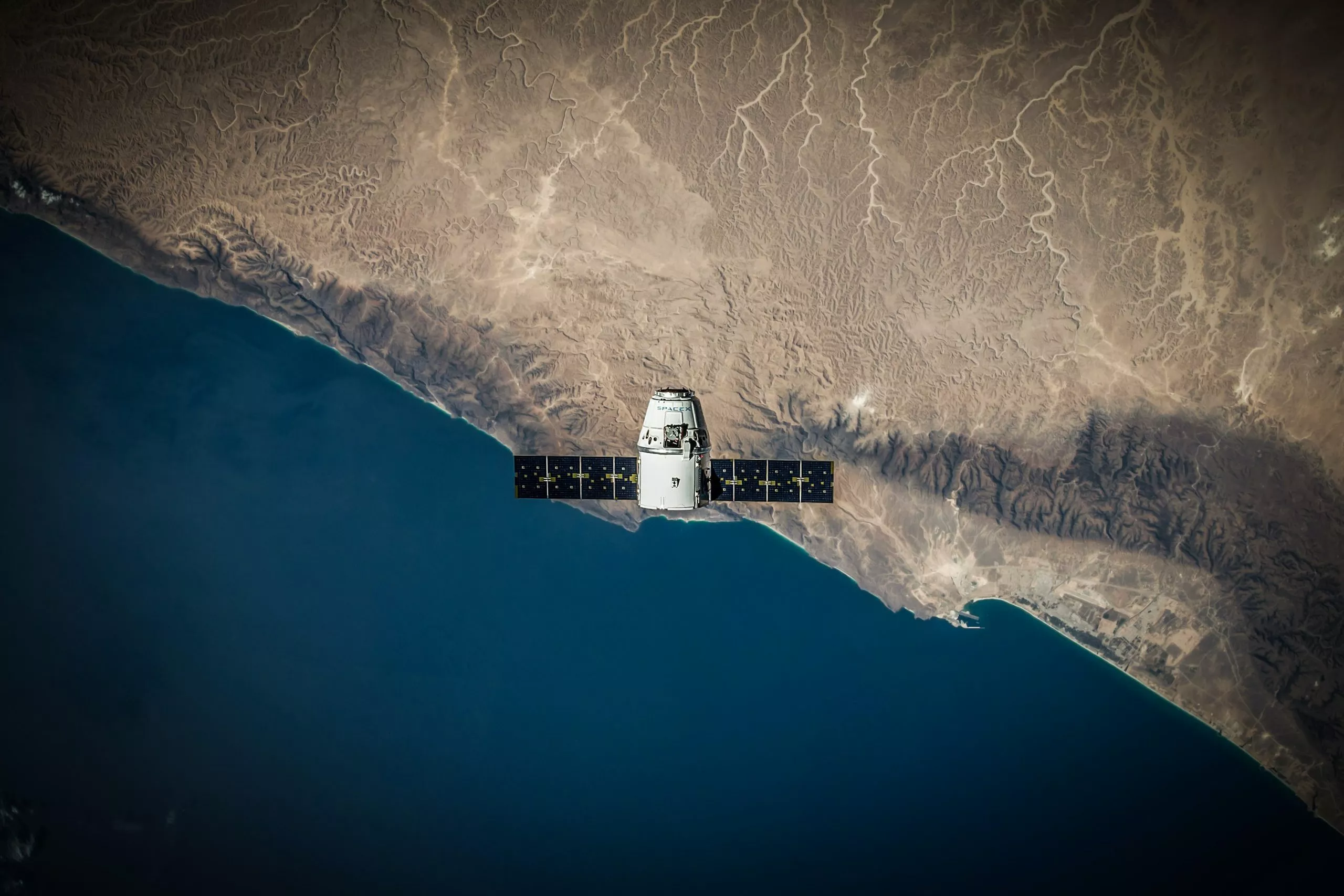
We’ve been talking a lot about terrestrial communications technology recently. For example, take a look at our articles on the history of mobile technology, or on the applications of 5G. However, that’s not the only kind of communications technology we work with at Darwin. We’re enabling seamless, reliable connectivity by harnessing transmitters both on Earth and in space. Today, we’re discussing different types of satellite orbit. How do satellites get into orbit? Satellites are taken into space by rockets and released at high speed, travelling over the Earth at thousands of kilometres per hour. The pull of Earth’s gravity prevents the satellite from flying off into space, but the speed of the satellite prevents it from being pulled down to the surface, as the curvature of the Earth means the ground is always falling away. This combination means that the satellite falls into orbit, looping constantly around the planet. What does LEO stand for? LEO stands for ‘low Earth orbit’. LEO satellites orbit the Earth between 160 km and 1,000 km above the planet’s surface, or between 160 km and 2,000 km according to some definitions. The pull of Earth’s gravity becomes stronger as you approach the planet. Because of this, LEO satellites, being relatively close to Earth, need to move very, very fast to counteract gravity. For example, the International Space Station (ISS), at the relatively low altitude of 400 km, is moving at roughly 27,600 km per hour and orbits Earth about 16 times per day. Geostationary satellites, at the much higher altitude of 35,786 km, move at less than half that speed: about 11,000 km per hour. What does MEO stand for? MEO stands for ‘medium Earth orbit’, and refers to satellites orbiting the Earth between the LEO and GSO levels. As there’s disagreement over whether LEO ends at 1,000 or 2,000 km, some satellites may be considered to be in either LEO or MEO, depending on the definition used. What does GSO stand for, and what’s the difference between GSO and GEO? You might hear GSO and GEO satellites mentioned in similar contexts. The terms have some overlap, but they’re not identical. GSO stands for ‘geosynchronous orbit’, meaning the satellite’s orbit is synchronised with the rotation of the Earth. In other words, it takes a day for the Earth to complete a revolution, and it also takes a day for a GSO satellite to complete one orbit of the Earth. GEO stands for ‘geostationary equatorial orbit’. This is a type of GSO that follows the equator, travelling in the direction of Earth’s rotation. Satellites in GEO always appear to be in the same place, relative to Earth – so, for example, as the Earth rotates, a GEO satellite above Brazil will keep moving so it constantly remains above Brazil. All GSO satellites (including GEO satellites) are approximately 35,786 km above the Earth’s surface: the only altitude at which geosynchronous orbit can be maintained. Are there HEO satellites? Knowing that low and medium Earth orbit satellites exist, you might expect there to be a high Earth orbit satellite, or HEO. The acronym HEO is sometimes used for satellites, but it doesn’t stand for ‘high Earth orbit’. HEO is short for ‘highly elliptical orbit’, and it refers to orbits where, rather than remaining at approximately the same height above the Earth at all times, the satellite is much closer to the planet at some points in its orbit than at others. Satellites with elliptical orbits spend longer over some parts of the planet than over others, which can be useful for communications. What are the practical differences between LEO, MEO and GSO? The altitude of a satellite can affect a number of things. For example: Cost of launch. Travelling to higher altitudes requires more powerful, more expensive rockets and larger quantities of fuel, meaning that low-altitude satellites are less expensive to launch. This can pay off multiple times; for example, the low orbit of the ISS makes it less expensive to send up supply craft. Cost of satellite. Low-altitude satellites can be smaller and less powerful – and therefore less expensive – because they don’t have to transmit signals as far as high-altitude satellites. Function. Some orbits are more useful for particular purposes than others. For example, satellites designed to observe or photograph Earth are often in relatively low orbits. Ability to provide consistent or widespread coverage. Because they have to move so quickly, a single LEO communications satellite won’t stay over any one location for long, meaning that you’ll need a lot of them to provide reliable coverage to that location. GEO satellites will stay in position, and their high altitude means that they can cover a large area, but they can only be positioned above the equator. The further from the equator you are, the less useful GEO satellites become. Latency. Signals have further to travel to and from high-altitude satellites, which means that a person connecting to a satellite may notice slightly longer delays in retrieving information from satellites at higher altitudes. Speed of orbital decay. Satellites in low orbit can encounter atmospheric drag, slowing them down and allowing gravity to draw them closer to the Earth. The lower they are, the greater the drag, and the faster their orbit decays. This means that LEO satellites often need to be either reboosted, using their own engines or another spacecraft to restore speed and altitude, or replaced. Either option is expensive. In 2010, the Ad Astra Rocket Company estimated the annual cost of keeping the ISS in a stable orbit, which requires multiple reboosts per year, at $210 million. Maximum number of satellites possible. GEO satellites have a natural limit on how many can exist at a time, as they’re at a specific height (35,786 km) and need to travel a specific route (the equator). In his 2000 paper ‘A Lost Connection’, published in the Berkeley Technology Law Journal, Lawrence D Roberts estimates that the equator can only hold up to 1,800 GEO satellites, and that many of the potential satellite positions wouldn’t be useful. At the moment, there are over 500 active GEO satellites. According to the UCS, there are currently over 3,000 operational satellites in our skies. We’ve come a long way since the Soviet Union launched the first manmade satellite, Sputnik 1, in 1957. In a future post, we’ll look in more detail at what those satellites are actually used for. Darwin Innovation Group is a UK-based company that provides services related to autonomous vehicles and communications. If you’re interested in working with us, take a look at our careers page. If you’d like to know how we can help your organisation make use of autonomous vehicles, contact us. You can also follow us on LinkedIn or Twitter.
Read moreless
1 21 22 23 24 25 29

News tags