NEWS

14 July 2022

What is the James Webb Space Telescope?

What is the James Webb Space Telescope?

NASA has released the first images from the James Webb Space Telescope, creating a stir across the planet. We make use of Earth satellites at Darwin, so our involvement with space is closer to home, but we’re still excited about this new glimpse into our universe. Here’s a quick look at the new space telescope.

NASA has released the first images from the James Webb Space Telescope, creating a stir across the planet. We make use of Earth satellites at Darwin, so our involvement with space is closer to home, but we’re still excited about this new glimpse into our universe. Here’s a quick look at the new space telescope. What is a space telescope? Space telescopes are used to observe and photograph space, but that’s not why they’re called space telescopes. To be a space telescope, a telescope needs to be in space. It’s obviously difficult and expensive to establish a telescope in space, but it results in better-quality images of space. Earth’s atmosphere distorts the light that passes through it; this is why stars seem to twinkle when we look up at them from Earth. Because space telescopes are put into orbit above Earth’s atmosphere, they can avoid this distortion and take clearer photographs of what’s out there. What is the James Webb Telescope? As the name suggests, the James Webb Space Telescope is a space telescope. It was developed by multiple space agencies working together; NASA, ESA and CSA all had a role in its creation. The James Webb Space Telescope was named after James Edwin Webb, who was the administrator of NASA between 1961 and 1968. It’s also known as JWST or Webb. Webb was launched on Christmas Day in 2021 as the successor to the Hubble Space Telescope, launched in 1990, although the Hubble Space Telescope is expected to continue operating for the next few years. Webb is about half the weight of Hubble in Earth’s gravity, but it’s considerably larger, it’s much more powerful and it has a larger field of view. Webb was also designed with infrared photography in mind, whereas Hubble focuses more on the visible and ultraviolet spectrums. Unlike the Hubble Space Telescope, which orbits the Earth, the James Webb Space Telescope orbits the sun. It’s about a million miles further from the sun than Earth, and it took a month to reach its orbital point, known as the Sun–Earth L2 Lagrange point (or simply L2), after its launch. At L2, Webb is able to orbit in line with the Earth around the sun, meaning that the sun and the Earth are always in the same direction from Webb’s perspective. This is important because it means Webb’s sunshield can constantly face the Earth and sun, blocking their light and heat and preventing interference with Webb’s infrared detectors. Because it’s so far from Earth, Webb was designed with the understanding that it wouldn’t be possible to visit it for repairs, whereas Hubble is in low Earth orbit and has been serviced on several occasions. How do space telescopes see back in time? It’s often mentioned that space telescopes can see the past. How is that possible? Powerful telescopes can detect light from sources a great distance away, but that light takes time to travel across space. Light years are a measure of distance based on how long it takes light to travel that distance; for example, if a star is 20 light years from the telescope, that means its light reaches the telescope 20 years after it first left the star. In other words, what the telescope sees is what the star looked like 20 years ago. If a spaceship flew directly in front of the star, the telescope would only see the spaceship 20 years later. This means that, strictly speaking, you can also see the past with your eyes. Light from the moon takes slightly over a second to reach the Earth, so, when you look up at the moon, you’re seeing it as it was a second ago. Rigel is one of the visible stars in Orion, so we’d notice if it exploded, but not for a while; it’s about 860 light years away, so we wouldn’t see the explosion for centuries. If you were somehow on Rigel looking at Earth, 860 light years away, the Earth you saw would be the Earth of the twelfth century. If you had an excellent telescope, you might be able to see Henry II going about his business. A lot has happened on Earth since then, of course, but you would only be able to see the light that’s had the time to reach you. For an example using a different sense, think about lightning. Thunder and lightning happen in the same instant; thunder is the sound of lightning. But, because light travels faster than sound, you’ll see the lightning from a nearby storm before you hear the thunder. When the thunder reaches you, you’re hearing a sound that occurred in the past; you know, from the fact you’ve already seen the flash of the lightning, that it’s not happening right now. Essentially, the further away something is, the further in the past our perception of it is. Because a powerful telescope like Webb can see things that are hugely far away, it can also see things a long way in the past. Unfortunately, it’s not possible to control this; if a planet is a thousand light years away, Webb can see what it was like a thousand years ago, but it can’t see what it was like ten thousand years ago or what it’s like right now. Even if Webb’s ability to see the past is limited in some ways, it’s still remarkable, and it may be able to give us more insight into the origins of the universe. We’re looking forward to seeing what it discovers. Cover image: NASA, ESA, CSA, STScI Darwin Innovation Group is a UK-based company that provides services related to autonomous vehicles and communications. If you’re interested in working with us, take a look at our careers page. If you’d like to know how we can help your organisation make use of autonomous vehicles, contact us. You can also follow us on LinkedIn or Twitter.
Read moreless

5 July 2022

Mitsubishi Heavy Industries and the University of Oxford visit Darwin

Mitsubishi Heavy Industries and the University of Oxford visit Darwin

On 17 June, we welcomed visitors from Mitsubishi Heavy Industries (MHI) and the University of Oxford!

Dr Sunao Aoki, former senior executive vice president and current special advisor at MHI, and Professor Budimir Rosic, associate professor of engineering science at St Anne’s College, paid a visit to Harwell Science and Innovation Campus, where Darwin’s UK office is based.

On 17 June, we welcomed visitors from Mitsubishi Heavy Industries (MHI) and the University of Oxford! Dr Sunao Aoki, former senior executive vice president and current special advisor at MHI, and Professor Budimir Rosic, associate professor of engineering science at St Anne’s College, paid a visit to Harwell Science and Innovation Campus, where Darwin’s UK office is based. At Harwell HQ, Monika Zemla presented the campus’s vision for the future in her role as associate director of Harwell Campus. We then visited the European Space Agency (ESA), where Roberta Mugellesi Dow, ESA’s integrated applications manager, spoke about exciting projects to come and ESA’s work in collaboration with the Japanese Space Agency. At the Darwin SatCom Lab, the Darwin team demonstrated some of the things we’ve achieved in our work with communications technology and autonomous vehicles. Our guests also had the opportunity to take a ride in the Darwin Autonomous Shuttle, one of the first self-driving passenger services in the UK. It was a pleasure to speak to Dr Aoki and Professor Rosic, and we hope they enjoyed the day! Darwin Innovation Group is a UK-based company that provides services related to autonomous vehicles and communications. If you’re interested in working with us, take a look at our careers page. If you’d like to know how we can help your organisation make use of autonomous vehicles, contact us. You can also follow us on LinkedIn or Twitter.
Read moreless

28 June 2022

‘Darwin the Shuttle Runs Away’ children’s book launches at Harwell

‘Darwin the Shuttle Runs Away’ children’s book launches at Harwell

On Tuesday 7 June, our children’s picture book ‘Darwin the Shuttle Runs Away’ had its official launch at Harwell Science and Innovation Campus!

The book was created by a mother-and-daughter team: Darwin’s Harriet Evans wrote the story, and her mum, Alison Evans, illustrated it by hand. For the launch, the Darwin team visited the on-campus Bright Horizons and Little Stars nurseries, where Harriet and Alison read to the children.

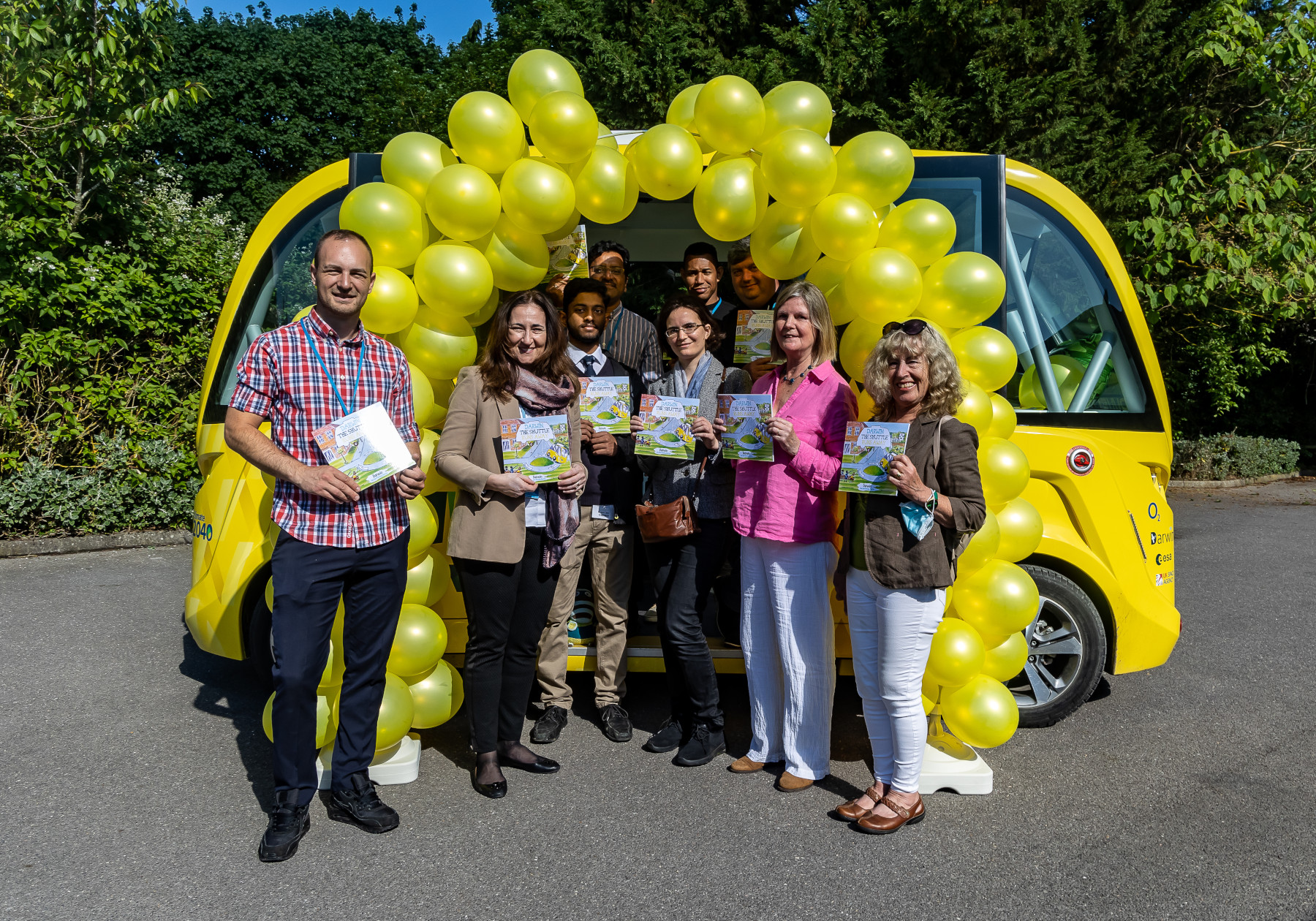
On Tuesday 7 June, our children’s picture book Darwin the Shuttle Runs Away had its official launch at Harwell Science and Innovation Campus! The book was created by a mother-and-daughter team: Darwin’s Harriet Evans wrote the story, and her mum, Alison Evans, illustrated it by hand. For the launch, the Darwin team visited the on-campus Bright Horizons and Little Stars nurseries, where Harriet and Alison read to the children. Alison demonstrated how she drew the shuttle, and apparently the children appreciated the lesson; we’re told they were still drawing Darwin after we’d left. Afterwards, each of the children got their own copy of the book to get home. They also had the opportunity to meet the actual Darwin Autonomous Shuttle the story was based on! It was a great day for all involved. Thank you to the Bright Horizons and Little Stars nurseries for hosting us, and we hope you enjoyed the book! ‘Darwin the Shuttle Runs Away’ by Harriet Evans, with illustrations by Alison Evans (Darwin Innovation), is available on Amazon for £8.99. Darwin Innovation Group is a UK-based company that provides services related to autonomous vehicles and communications. If you’re interested in working with us, take a look at our careers page. If you’d like to know how we can help your organisation make use of autonomous vehicles, contact us. You can also follow us on LinkedIn or Twitter.

Read moreless

14 June 2022

How are satellites powered?

How are satellites powered?

Satellites often stay operational for years, in an environment where it would be enormously difficult and expensive to pop by and change the batteries. That raises an obvious question: where do satellites get their energy from?

Satellites often stay operational for years, in an environment where it would be enormously difficult and expensive to pop by and change the batteries. That raises an obvious question: where do satellites get their energy from? What do satellites use power for? A satellite in orbit doesn’t generally need power in order to keep orbiting, with occasional exceptions that we’ll look at later on. Satellites mainly use their power supplies to maintain their electronic systems. This enables them to carry out the tasks they were designed for: photography, for example. It also allows them to transmit to or receive transmissions from Earth. Because power isn’t necessarily essential to keep a satellite orbiting, it’s possible for a satellite to run out of power but remain in orbit. This is a problem, as it means the satellite is no longer performing a useful function, can’t be controlled from the ground and may obstruct other satellites. If you’re interested in how satellite operators dispose of satellites before they run out of power, take a look at our article ‘What happens to old satellites?’ Solar-powered satellites There’s one clear source of energy for satellites to draw on: the sun. Because satellites orbit above the clouds, they don’t experience the drop in energy production that Earth-based solar panels face during overcast days. Solar energy began to be used very early in the history of artificial satellites. The first solar-powered satellite was Vanguard 1, the fourth artificial satellite to go into orbit around Earth (and the oldest manmade object still orbiting), which was launched by the US on 17 March 1958 and has now been in space for over sixty years. Although clouds aren’t a concern for satellite solar panels, satellites don’t always have access to solar energy. At times, the Earth will be between the satellite and the sun; in other words, from the satellite’s perspective, the sun will be eclipsed. Because of this, it’s necessary to have a source of power that can be used in darkness. This power is provided by rechargeable batteries. These batteries are charged by solar energy when the sun is visible. When the sun is eclipsed by the Earth, the charged batteries can still power the satellite, and they will be able to recharge when the satellite’s orbit brings it back into sunlight. These batteries don’t last forever – eventually, they’ll wear out to the point where they can’t hold a charge – but they can keep a satellite in operation for years. Satellite fuel Solar energy can help satellites carry out their day-to-day tasks and communications. If the satellite needs to be moved, though, it requires fuel. In the normal course of orbit, a satellite doesn’t need to burn fuel; it’s kept moving by gravity and the lack of friction in space. However, satellites are generally launched with some fuel, which can be used to operate thrusters in a variety of situations. For example, fuel is useful for: Moving the satellite into the intended orbit. Reboosting a low Earth orbit (LEO) satellite by increasing its altitude and speed, ensuring that it stays in orbit for longer. LEO satellites tend to experience small amounts of atmospheric drag, causing their orbit to decay over time, and will fall out of orbit without occasional reboosting. Avoiding collisions with other satellites or space debris. Satellite operators need to stay aware of potential collisions and take action if the risk becomes too high. The ESA infographic ‘The Cost of Avoiding Collisions’ explains that, on average, each of ESA’s Earth satellites needs to be moved twice per year to avoid a potential collision. Disposing of a satellite by slowing it down at the end of its life, causing it to fall into the atmosphere. Disposing of a satellite by raising it into an orbit beyond all currently active satellites: a ‘graveyard orbit’. The fuel that satellites use in the present day is generally hydrazine-based. Because hydrazine is toxic and must be handled in full-body protective gear, the space industry is conducting research into safer fuels to work with. We’ve already seen substantial changes in how satellites are powered. The first artificial satellite, Sputnik 1, had no solar panels and was powered entirely by batteries, which ran out three weeks after its 1957 launch. In the future, we’re likely to see more improvements, from safer fuel to longer-lasting rechargeable batteries. Darwin Innovation Group is a UK-based company that provides services related to autonomous vehicles and communications. If you’re interested in working with us, take a look at our careers page. If you’d like to know how we can help your organisation make use of autonomous vehicles, contact us. You can also follow us on LinkedIn or Twitter.
Read moreless

1 June 2022

‘Darwin the Shuttle Runs Away’, a children’s book about self-driving vehicles, is out now

‘Darwin the Shuttle Runs Away’, a children’s book about self-driving vehicles, is out now

A new children’s picture book puts a fresh spin on Thomas the Tank Engine and brings it up to date with the modern age.

‘Darwin the Shuttle Runs Away’ (published by Darwin Innovation) is inspired by a real-life autonomous shuttle bus recently launched by Darwin Innovation Group, a hi-tech company based in Harwell, Oxfordshire.

A new children’s picture book puts a fresh spin on Thomas the Tank Engine and brings it up to date with the modern age. Darwin the Shuttle Runs Away (published by Darwin Innovation) is inspired by a real-life autonomous shuttle bus recently launched by Darwin Innovation Group, a hi-tech company based in Harwell, Oxfordshire. Author Harriet Evans (33), from London, wrote the book, and her mum Alison illustrated it by hand. The author, Harriet Evans (right), and the illustrator, Alison Evans (left) ‘Self-driving cars sounded like science fiction not long ago, but now they’re reality,’ Harriet said. ‘The real-life Darwin Autonomous Shuttle drives, stops and picks up passengers by itself. It can navigate and avoid obstacles using cameras, sensors, and information from mobile networks and satellites. Children love the shuttle. They are very open-minded and enthusiastic about the idea of driverless buses.’ The book is for pre-schoolers and early schoolers and its aim is to simultaneously educate and entertain. Nursery children have been celebrating the launch of the book at Harwell Science and Innovation Campus, where the real-life shuttle currently operates, and there are plans for more books about Darwin’s adventures in the future. Harriet explained that her storyline reflects some of the issues of traditional and emerging transport existing side by side, as well as more human concerns about not being good enough. ‘Darwin is a determined but insecure little self-driving vehicle. When she runs away to Oxford to become a bus, she learns that it’s not as easy as it seems – no matter how much advice you get from actual buses. Through her journey, Darwin learns that it’s okay to be different, and that she can rely on her friends for support instead of running away from problems.’ ‘I forgot for a moment that Darwin was a bus,’ an eight-year-old reader said. ‘I felt like Darwin was a human. I understood all her feelings and felt that she would understand mine.’ The real-life Darwin bus has only recently been launched, with plans to roll out more in cities around the UK and Spain over the next couple of years. Blue Peter has already featured the bus, watched by around 46,000 viewers. ‘Darwin the Shuttle Runs Away’ by Harriet Evans, with illustrations by Alison Evans (Darwin Innovation), is available on Amazon for £8.99. Darwin Innovation Group is a UK-based company that provides services related to autonomous vehicles and communications. If you’re interested in working with us, take a look at our careers page. If you’d like to know how we can help your organisation make use of autonomous vehicles, contact us. You can also follow us on LinkedIn or Twitter.
Read moreless
1 13 14 15 16 17 29

News tags